
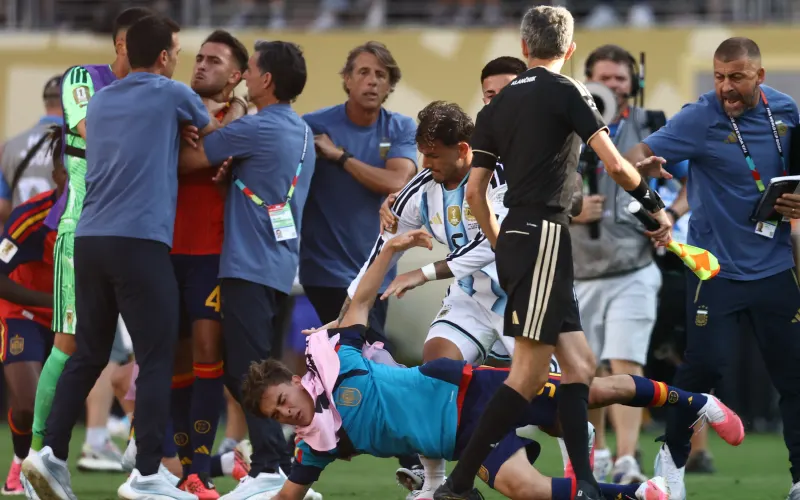
The world called it a “brawl”. Women recognised something else. They recognised the entitlement. The aggression. The belief that anger can become an excuse for physical force.
They recognised a pattern that too many women experience behind closed doors every single day. And this is where our language matters. Because when men use violence, we often soften the words before we even confront the behaviour.
The headlines said:
“Brawl.”
“Clash.”
“Heated scenes.”
But a “brawl” sounds like a moment of chaos. A loss of control. Two equal sides caught up in emotion. Violence is different. Violence is a choice. Strip away the stadium. Strip away the shirts. Strip away the fame. What are we actually watching? Men using aggression and physical force against other men.
And we need to be honest about what we call it.
Because language shapes how seriously we take violence.
When we call it a “brawl”, we risk turning something serious into just another dramatic moment in sport — something that happened because emotions ran high, because the stakes were big, because the game mattered.
But emotions do not force someone to use violence. Frustration does not force someone to use violence. Losing does not force someone to use violence. People choose violence.
And when we soften the language, we soften the accountability. It is about recognising a much bigger issue:
A culture that has spent too long excusing, minimising and explaining away men’s aggression instead of challenging it. Because change cannot happen until we are willing to name the behaviour honestly. It was not just a “brawl”. It was men’s violence.
And the words we choose tell us everything about how seriously we are prepared to take it.
The Numbers Nobody Cheers For
While the world was watching Spain lift the 2026 World Cup, researchers already knew what the data would show once the dust settled.
A landmark Lancaster University study of English police data found domestic abuse reports rose 26% when England won or drew, and 38% when they lost. Not a typo. Winning doesn’t protect you. Losing just makes it worse.
Warwick Business School researchers, digging through a decade of West Midlands police data, found alcohol-related domestic abuse spiked 47% after an England win — starting during the match, peaking in the three hours after the final whistle.
During Euro 2024, the UK charity Respect logged a 24% jump in calls to its Men’s Advice Line and a 39% jump to its Respect Phoneline. Leeds Women’s Aid saw a 22% rise in calls in the tournament’s first week alone. 95% of those callers were women.
This isn’t a British phenomenon. It isn’t a one-off. It’s a pattern that repeats, tournament after tournament, country after country, because the common denominator was never the sport. It was always what some men do with their anger once the cameras stop rolling and the front door closes.
Behind every one of those percentage points is a woman who knew, before the match even kicked off, what kind of night she was walking into. A child upstairs, listening. No names. Just numbers, quietly filed away, while the rest of us argue about penalties and possession stats.
Then, on Sunday, the Cameras Kept Rolling
For once, the world didn’t have to imagine what that anger looks like. It watched it happen live, in front of a global audience, seconds after Spain’s 1-0 extra-time win.
Leandro Paredes grabbed Eric García by the throat. He shoved Gavi to the ground. Nahuel Molina threw punches toward Spain’s captain, Rodri. Nicolás Otamendi squared up with several Spanish players. Argentina’s own assistant coach was seen striking Dani Olmo. It took Lionel Scaloni and multiple players from both sides to physically pull grown men apart on the pitch where they’d just played a World Cup final.
FIFA has opened an investigation.
Here’s the uncomfortable question worth sitting with, if grown men, the most-watched athletes on the planet, with billions of eyes on them, will grab a colleague by the throat on live television because they didn’t like losing, what does that tell us about the version of themselves nobody’s filming?
That’s not a leap. That’s the same instinct the research keeps finding a name for.
What the Other Side Looked Like
Spain didn’t need a brawl to make their point. Lamine Yamal dropped to his knees in quiet relief. Spain’s players had spent the tournament being praised for how they carried themselves — win or lose — and Sunday night, the contrast between the two benches said more than any post-match interview could.
Grace isn’t a tactic. It’s a choice, made repeatedly, under pressure.
A Country That Shows Up, Off the Pitch Too
Spain’s conduct on Sunday didn’t happen in a vacuum. It’s a team that plays for a country which has spent the last two years positioning itself as one of Europe’s loudest governments on the suffering and violence in Gaza.
True leadership.
A Spanish squad that, win or lose, has spent this tournament being talked about for its composure — and an Argentine bench that gave the world a very different highlight reel.
It’s Not All Men. It’s Always A Man.
Nobody sensible is saying every man is a threat. Most aren’t. Most would never.
But when the violence does happen — on a pitch in front of 80,000 people, or behind a closed door with no cameras at all — it is, overwhelmingly, still a man’s hands doing it.
That’s the thread connecting a World Cup brawl to a spike in 999 calls: not football, not alcohol, not “passion” — a permission some men still quietly give themselves to turn frustration into force, the second they think no one important is watching.
Sunday night, for a few seconds, someone was watching. FIFA has a chance to say clearly that this isn’t tolerated at any level, from the biggest stage in the sport down to the living room. Whether they take it is another matter.
If you or someone you know is experiencing any form of abuse, please reach out to Women’s Aid.
- Ireland — Women’s Aid 24-Hour National Freephone Helpline: 1800 341 900, or womensaid.ie
- Northern Ireland – Women’s Aid 028 9024 9041 or website for all local numbers HERE
- UK — National Domestic Abuse Helpline: 0808 2000 247
Subscribe to The FEMCAST and help us bring these critical stories to light. Each listener, each voice, and each story makes a difference. Together, we can break the silence.
If you enjoy our content and would like to support our research and work, consider buying me a coffee. Your contribution helps me continue creating this content. Thank you for your support!