
You can be successful and still be bullied.
You can be highly respected and still be targeted.
And you can walk into work every day terrified of the person who signs your pay cheque.
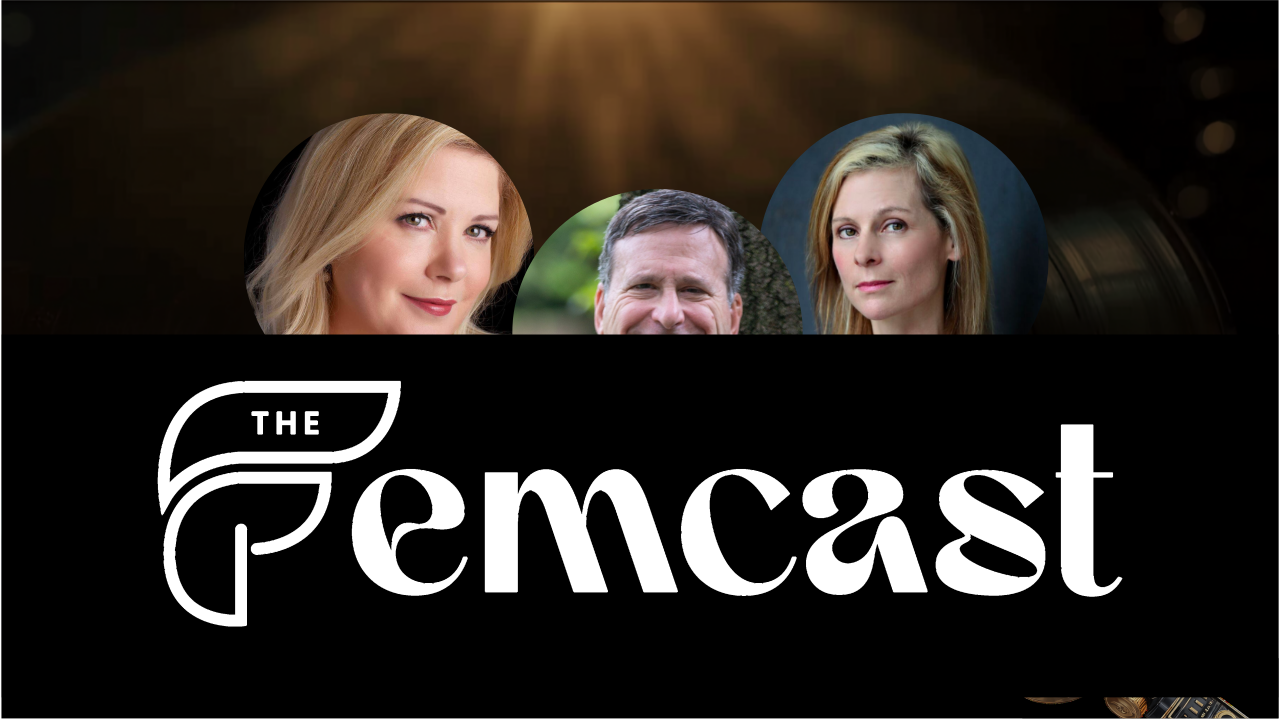
That is the uncomfortable truth at the heart of our latest episode on The FEMCAST podcast.
This week, we’re joined by Andy Regal, a veteran media executive whose career spans four decades and some of the biggest names in American broadcasting, including Court TV, CNBC, MSNBC and The Wall Street Journal.
Andy has the accolades. A Loeb Award. Multiple Emmy nominations. Decades of leadership experience. But behind that success is another story.
A story about workplace bullying, humiliation, fear, retaliation and psychological safety — or the complete absence of it.
Andy’s book, Surviving Bully Culture, tells that story with extraordinary honesty.
The red phone
One of the most striking moments in our conversation is Andy’s story of the red phone.
It was a direct line to his boss. Andy had created and executive produced a hugely successful show that generated millions for the network. Yet whenever that phone rang, his heart would race because he knew the call could bring threats, scorn or the possibility of being fired.
Not every day. But that was almost beside the point. He never knew when it was coming. And that uncertainty matters because psychological safety isn’t simply about whether someone is shouting at you today. It’s about whether your brain believes you are safe tomorrow.
As Andy explains, living under the constant possibility of attack changed the way he experienced work — and ultimately damaged him. That is something we need to understand much better. Because people often say: “But they don’t do it all the time.” As though that makes it acceptable. It doesn’t.
The bully doesn’t always look like a bully
We have a very particular image of a workplace bully. The shouting boss. The aggressive manager. The person everyone can see coming. But bullying can be far more sophisticated than that. Andy talks about the “brilliant jerk” — the person who is successful, charismatic, powerful and seemingly indispensable. The person who gets results. The person senior leadership protects. The person everyone knows is difficult but nobody wants to challenge.
And sometimes, remarkably, the people who become targets aren’t the weakest people in the room. They’re the strongest. Andy describes how his empathy, collegiality and genuine care for his colleagues may actually have made him more visible to someone who disliked those qualities.
And that’s an important conversation.
Because we need to stop asking:“Why didn’t they stand up for themselves?” And start asking: “Why did the organisation allow this behaviour to continue?”
The shame that doesn’t belong to you
This is something that has come up repeatedly throughout our conversations around bullying and gaslighting. The person doing the harm creates the behaviour. Yet somehow, the person being harmed ends up carrying the shame. Andy talks powerfully about the shame of being unable to counter a bully, particularly as a man who had spent his career as a leader.
And that shame can become another weapon.
You start questioning yourself. Maybe I’m not as good as I thought. Maybe I’m too sensitive. Maybe I caused this. Maybe I should just try harder. And you do.
You work harder. You become quieter. You try to anticipate their moods. You monitor every email. You watch the door. You wait for the next phone call. And slowly, survival replaces performance.
This isn’t a “people problem”
One of the most important points to come out of our conversation is that workplace bullying cannot simply be dismissed as a personality clash or an unfortunate disagreement between colleagues.
It is a culture and leadership issue.
Andy argues for something refreshingly straightforward: clear codes of conduct, proper accountability and consequences when people repeatedly breach those standards. Because we already understand how to protect people physically at work. We have hard hats. Safety boots. High-vis clothing. Risk assessments. Inductions. Safety procedures.
We don’t tell someone working on a construction site: “That’s just what your supervisor is like. Try not to upset him.” So why do we accept the psychological equivalent? Why is protecting someone’s mind still treated as optional?
Psychological safety should not be a luxury
If an employee spends their working week anticipating humiliation, retaliation or attack, they aren’t operating at their best. They’re operating in survival mode. And that isn’t good for the employee. It isn’t good for the team. And ultimately, it isn’t good for the business.
The irony is that organisations can spend enormous amounts of money recruiting talented people — and then allow one toxic individual to systematically destroy their confidence, wellbeing and career.
Andy knows this from the inside.
And his message isn’t one of anger.
It’s one of hope.
He believes we can change workplace culture by bringing these conversations into the open and refusing to normalise destructive behaviour. So do I. We have to stop normalising the unacceptable
Perhaps the biggest question from this episode is a simple one: What have we normalised because we’ve been told that’s just how work works?
The screaming boss. The humiliating manager. The “brilliant jerk”. The favourite employee. The person who can do whatever they like because they’re a rainmaker. The colleague everyone warns you about — but nobody stops. The complaints that disappear into HR. The employee who eventually leaves while the perpetrator remains. None of this is inevitable. And none of it should be normal.
A safe workplace isn’t one where nobody ever disagrees. It’s one where people can disagree without fear. Where leaders can be challenged. Where mistakes can be admitted. Where concerns can be raised. Where power has boundaries. And where success never gives someone a licence to abuse the people around them.
In this episode of The FEMCAST, Andy Regal takes us behind the headlines and into the reality of surviving bully culture at the highest levels of media. It’s raw. It’s honest. And, ultimately, it’s hopeful. Because the more we talk about workplace bullying, the harder it becomes to hide it.
And perhaps someone listening needs to hear this today: If your workplace is making you feel unsafe, that doesn’t automatically mean you’re the problem. Sometimes the culture is the problem. Sometimes the power is the problem. And sometimes, the bully is the problem.
🎙️ Listen to the full episode of The FEMCAST with Andy Regal.
If this resonates with you, share it. Someone else may be carrying shame that was never theirs to carry.
Buy Andy’s book HERE
The FEMCAST … Amplifying voices for safer cultures.
Subscribe to The FEMCAST and help us bring these critical stories to light. Each listener, each voice, and each story makes a difference. Together, we can break the silence.
If you enjoy our content and would like to support our research and work, consider buying me a coffee. Your contribution helps me continue creating this content. Thank you for your support!